Articles tagged with "Privacy"
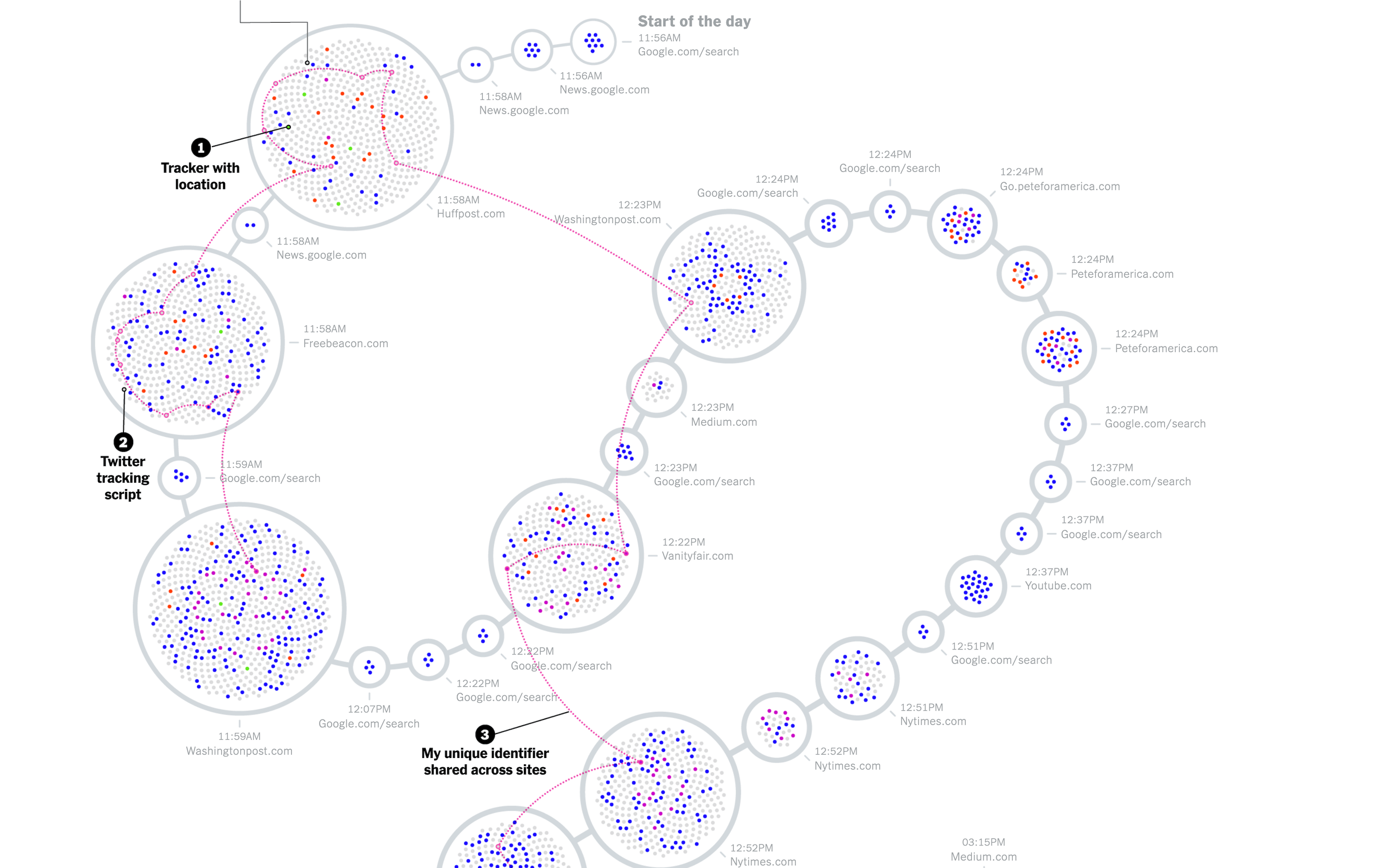 Credit: Visual Cinnamon & NY Times
You Have an Obligation to Fight for Privacy

Note: The header image was created by Visual Cinnamon for The New York Times on an opinion piece on digital trackers. By now everyone is familiar and desensitized to cookie popups that bombard us on our first visit to almost every. These cookie consent alerts are there for a reason, they are required by new legislation such as GDPR and the California CPA. This legislation has been introduced to try to protect consumers from boundless data collection policies , which is a laudable goal. I’m not certain how much of a difference it’s made though as most users accept the terms as quickly as a EULA or a Windows Security Warning popup. Recently Senator Sherrod Brown has realized this and is trying to shift the burden of privacy from consumers onto the companies that hold the data. No longer will it be enough for a company to fall back on the “but you clicked on the Privacy Policy button” defense:
Read more >>
 Credit: Smithsonian American Art Museum and its Renwick Gallery
Exploring the Darkweb
The best way to understand attacker tools, data breaches, and the underground marketplaces is to go to the source and learn what we can. Join me on a tour of the Darkweb. Warning: the following action should be performed by trained professionals only. Do not attempt this at home. One of the great benefits of large scale network connected computers is that it allows likeminded people to build communities in order to share ideas, techniques, tools, and software. These capabilities have been a powerful instrument in effecting political and social change. In the same way, though, it can be used to help illegal or problematic groups to organize. Once connected, members can undertake some of society’s worst activities, including buying and selling stolen data, illicit goods, and coordinating illegal real-world activities such as human trafficking.
Read more >>
Google’s Global Adaptive Authentication
Passwords are the scourge of application security. Password reuse is rampant, data breaches compromising poorly stored passwords are common, passwords are difficult to remember and easy to crack, password guidance is inconsistent. Against all these odds we put the responsibility of account security squarely on the shoulders of our users. We give them tools that will make them more secure, but are difficult to use like Multi-Factor Authentication and Password Managers. But then we layer on the complexity with each new technology. For example, is is SIM card cloning as easy, or as bad as some security professionals may have you believe?
Read more >>

Privacy as a Differentiator
I really appreciate the efforts that Apple has made to protect the privacy of their users. In my mind this does two things. First, it offers a model of competition where other companies can see Apple’s success in protecting data while providing competing features. Second, it gives customers an option to “un-subsidize” the common advertising and data-as-currency model for cheap devices. The problematic component of this means that we could end up with a two tier privacy model whereby an individual can maintain the privacy of their data and self only if they are able to pay for it. This means privacy is only accessible to well-off or well-educated individuals who have the means to control their data. This is problematic, to be sure, but it’s a step in the right direction and better than a world in which no-one has a choice about being tracked at all.
Read more >>